Spring 2026
As we celebrate the 10th Anniversary of our organization, we also acknowledge the evolution of our newest endeavor: Wind & Warrior Institute for Liberatory Healing has been engaged since 2023 in fostering sanctuaries of learning through our Practitioner Training programs. Within the Institute, practices of cultivating belonging while fostering accountability are intentionally woven through communal cultural ritual.
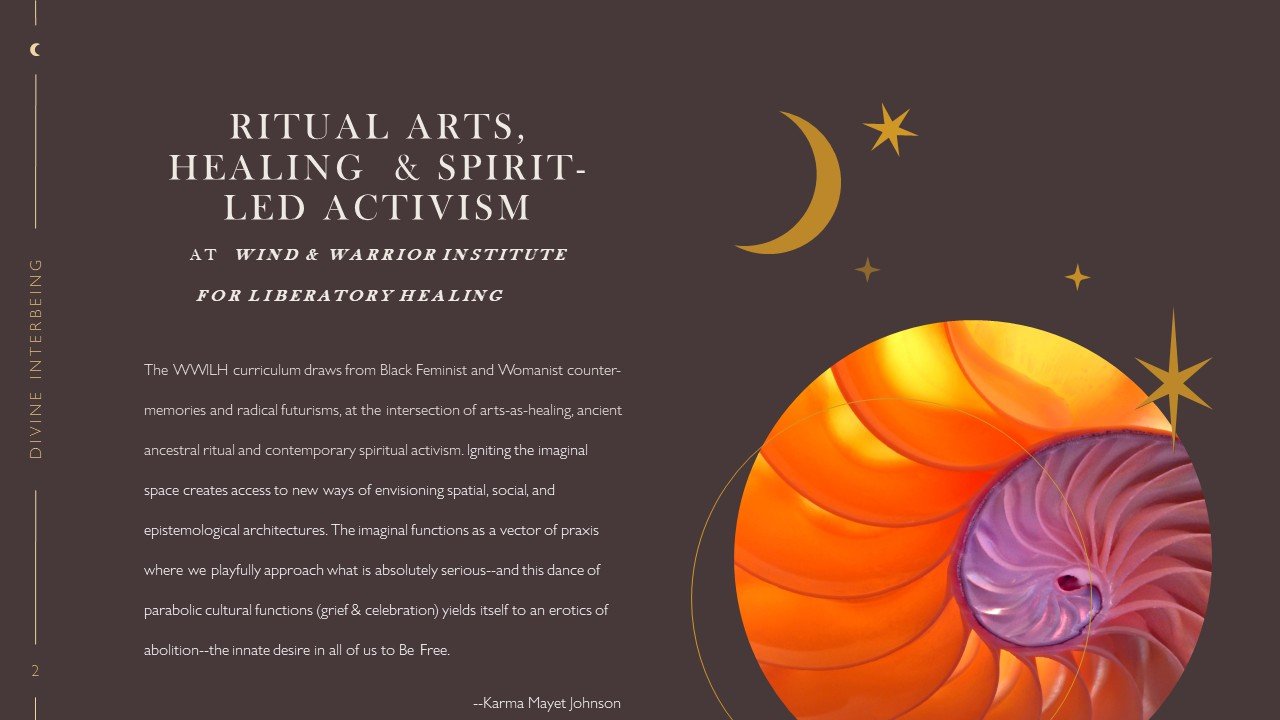
We begin with the understanding of belonging and accountability as covalent. We know that igniting the imaginal space creates access to renewed ways of envisioning spatial, social, and epistemological architectures. The imaginal can function as a vector of practice where we playfully approach what is absolutely serious. This dance of the parabolic cultural functions of grief and celebration yields itself, then, to an erotics of abolition— the innate desire in all of us to be free. Indeed, all of our spiritual traditions offer guidance and pathways to Freedom as the yield of practice.
As Practitioners in the fields of Faith, Advocacy, Education, Law, Governance, the Arts, and Health & Well-Being, we build upon our diverse traditions of ancestral and cultural memory, and upon recent research in the fields of narrative medicine,[1] embodied relational justice, applied theater, and arts-prescribing for mental health, to gain access to a wealth of resources to support the transformation of our communities toward well-being and right relationship. Recent innovative initiatives such as the Arts for Everybody[2] pilot across 18 U.S. cities, have implemented research findings in arts’ impact on relational well-being across diverse public health contexts,[3] in a movement toward greater support for integral healthcare and the foregrounding of Medical Humanities. As contemporary researchers ‘discover’ elements of ancestral cultural science that have been embedded in our cultural practices for generations, we welcome more good company and we tend to the memories of our traditions, as our evidence-based inheritance.
One of the joys of designing and sharing curricula for WWILH is bringing the varied strands of me to the process. As a ritualist, and as an artist, I'm looking at story as the universal root of liberatory ritual. What informs my use of storytelling as medicine is my arts/healing praxis which emerges from a poetics of conjure, rooted in sacred relationality. A poetics of conjure recognizes the power of the word, spoken with intention and received with deep listening—to shift reality. Creative ritual cultivates resilience and innovation. Rites of remembrance can provide experiences of narrative healing that flow from being heard, being reflected, being affirmed, being believed.
It is our hope that through the cultivation of communal sanctuaries of practice, WWILH’s ecosystem of practitioners and communities can impact both public health and public policy in ways that support greater well-being among all, through the disruption of structural patterns whose consequences reproduce harmful outcomes across all sectors of our society and planet.
We thank you, our community, for your steadfast and unwavering love and support and for your wisdom, fortitude and imagination as you dance the dance that is yours only.
[1] Rita Charon, Sayantani DasGupta, Nellie Hermann, Craig Irvine, Eric R. Marcus, Edgar Rivera Colon, Danielle Spencer, Maura Spiegel, The Principles and Practice of Narrative Medicine. Oxford University Press, 2016.
[2] Americans for the Arts, “Arts Impact Explorer,” Accessed May 17, 2026. https://ww2.americansforthearts.org/explorer
[3] Jill Sonke, Virginia Pesata, Aaron Colverson, Jane Morgan-Daniel, Alexandra K. Rodriguez, Gray Davidson Carroll, Shanaé Burch, Abel Abraham, Seher Akram, Stefany Marjani, Cassandra Belden, and Hiba Karim, “Relationships between arts participation, social cohesion, and wellbeing: An integrative review and conceptual model,” medRxiv preprint https://ww2.americansforthearts.org/sites/default/files/2024-09/Relationships%20between%20arts%20participation%2C%20social%20cohesion%2C%20and%20wellbeing.pdf this version posted May 1, 2024.